

“With today’s newspaper in one hand
and poems in the other
I hesitate
should I first read to them the news
or the poems…”
– Kunwar Narain (translated by Apurva Narain)
I believe in a world where poetry is the only redemption for a language. Poetry translation, by that logic, is its ultimate salvation.
Perennial is a newly published volume of contemporary Hindi poetry, edited astutely by Sourav Roy and Tuhin Bhowal (published by Red River, 2025), that traces the chequered history of the Hindi language like a perennial river, flowing through various political and literary movements over the years. At a time when the Hindi language is much in need of redemption, the publication of this collection is timely. As Hindi is being wielded as one of the strongest political weapons in the country, this volume places its dual position of ‘colonised’ and ‘coloniser’ firmly in the centrestage. This collection is also a crucial reminder of the subversive historic traditions of the language. By documenting the works of 40 poets and 26 translators through 200 poems spanning across decades, this book takes up an audacious task but delivers in its promise.
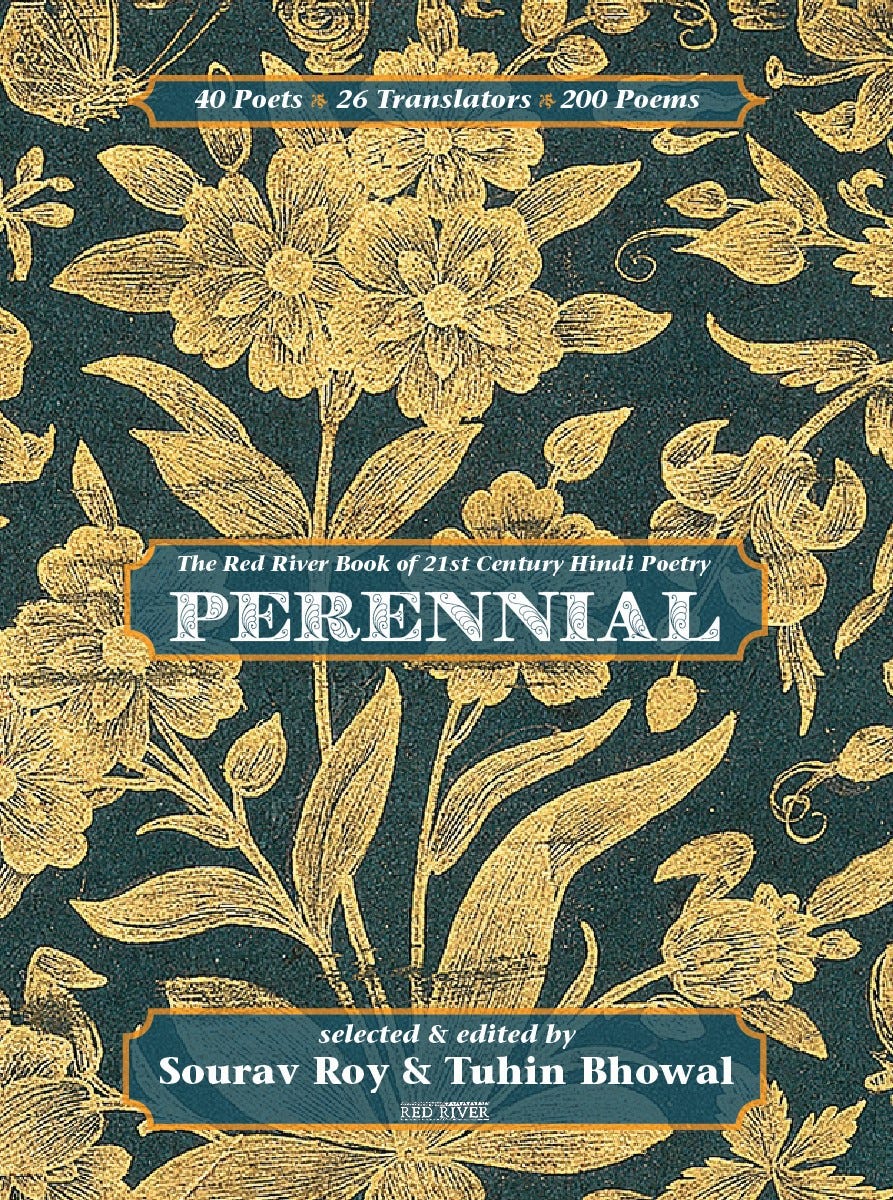
Roy’s erudite introduction to Hindi poetry takes us through every iteration of the language as it has evolved over the last 150 years or so. Along with describing salient features of various literary movements in Hindi—from Chhayavaad (Shadowism) and Pragativaad (Progressivism) to Prayogvaad (Experimentalism), Nayi Kavita (New Poetry) and even Akavita Andolan (lit. Non-Poetry Movement)—it also complicates the position of Hindi in the realm of national politics, as compared to other Indian languages or with respect to English. It talks about how the ‘spirit of questioning the status quo’ has always been at the core of Hindi poetry, as it has acted as an ‘antidote to petty politics’ in the country. But at the same time, it acknowledges the fact that with the growth and mainstreaming of Hindi over the years has come the inevitable victimisation of less standardised languages such as Maithili, Bundelkhandi, Santali, Garhwali, among others. The Census of India 2011 may show Hindi as the most widely spoken Indian language, but it obfuscates the hundreds of languages and ‘dialects’ and ‘mother tongues’ (or other similar terms used for minoritised languages) that get falsely categorised as Hindi. This is the reason that even as the Constitution of India recognises only 28 languages officially, the raw Census data points to more than 19,500 different tongues being spoken around the country.
The selected poetry in this collection is profound, philosophical and playful, but also hits hard. It speaks to political issues that have plagued the country before, during and after independence, and continue to remain relevant to address deep-seated social issues today. Poetry has a unique ability to put things in perspective, and a collection like this places poetry from every decade next to each other in an attempt to showcase the social patterns that have been repeating over the years. Poets range from Kunwar Narain (b. 1927), Mangalesh Dabral (b. 1948) and Gagan Gill (b. 1959) to Parwati Tirkey, Adnan Kafeel Darvesh and Vihag Vaibhav (all born in 1994). Be it issues surrounding language politics and anti-Hindi sentiments in the nation or communal violence, casteism and the existing sense of apathy in people, the poems in this collection are not afraid to take a stand. The second half of the collection really foregrounds contemporary voices on the margins and platforms the pain, oppression and hierarchies that continue to perpetuate, with all of us as perpetrators.
What struck me also was reading about the lives of the poets included in the collection and realising they too were translators of other poets and writers. The collection in that sense seems like a celebration of translation and translators, by bringing together some of the country’s most established names in translation alongside emerging translators in the same volume. I believe poetry translation is one of the most challenging and rewarding forms of translation work—and this collection manages to retain both music and meaning in its translation. There are translations by the editors Roy and Bhowal, and also feature translations by well-known names such as Sampurna Chattarji, Priyanka Sarkar, Apurva Narain, Abhimanyu Kumar, Dibyajyoti Sarma, Tanuj Solanki, and Areeb Ahmed, among others.
The collection also advocates for writing poetry in the mother tongue and self-reflexively engages with questions of language, language hierarchies and politics. It believes that “Poems should be written so that the poet doesn’t remain / an ideological minority” (Devi Prasad Mishra, translated by Priyanka Sarkar). The volume is a translation of contemporary Hindi poetry for a global audience in English, but it remains firmly rooted in its stance of celebrating the language it came from—through words, phrases and names that show up in their original language seamlessly in the translations.
“Often they appear simple
but a poet performs many complex tasks.
For instance, one complex task among many
is translating the sound of rivers gurgling.
Translating the sound of trees rustling.”
– Rajesh Joshi (translated by Sourav Roy)
Even as the Introductory Note attempts to cover too much ground at once, it references some of the most crucial aspects of Hindi literature and poetry over the years. From the nuanced evolution of children’s literature in Hindi through the circulation of magazines like Cycle and Pluto; to the spurt of expression of marginalised identities through poetry be it female, queer or Dalit voices in Hindi poetry—the collection manages to include as many voices as it can in this comprehensive effort. It also references the increasing lack of patience and attention that is required to read poetry; the Introduction observes that the grammar of poetry has been greatly hijacked by the ‘grammar of the screen’. Although one must also acknowledge that the grammar of a platform like Instagram sometimes even encourages the proliferation of poetry since it can easily be packaged in a shorter format for the visual medium. One also finds that videos of spoken or slam poetry in Hindi achieve viral status now and then, and makes one wonder if poetry is actually almost being supported by this ‘grammar of the screen’ more than anything else.
“This is what happened the last time
This is what will happen the next time too
We will meet again
in another city
and keep gawking at
each other’s face”
– Kedarnath Singh (translated by Tuhin Bhowal)
This is a collection that needs to be placed on your bedside and returned to over and over again—rather than a book that can be consumed all at once. Poets speak in different voices–through rhyme, free verse, shape poetry, lyricism and songwriting–and in no particular order. They ruminate, express, question, challenge, indict, celebrate and disrupt. It is a volume that will speak to you in different ways every time you revisit it, with every poet’s voice remaining timeless across the ages, and the translators deftly bringing out the nuances of their poetic craft. Much like a poetry pharmacy, it might even have a cure for every illness.
“What’s left now?
…
Our story is ending
but this poem is left.”
– Ashok Vajpeyi (translated by Sourav Roy)
About the Author:
Mohini Gupta is a writer and translator from New Delhi. She is currently a Postdoctoral Fellow at Aarhus University, Denmark. She holds a D.Phil. (PhD) in language and education from the University of Oxford. She is the co-founder of AfterWord India.